Choosing the right prescription optical frames in 2026 requires more than comparing colors, prices, and product photographs. Global buyers need dependable construction, accurate sizing, and clear communication throughout the purchasing process. A frame may look premium online, yet feel unbalanced after ten minutes of wear. Small details matter.
This guide examines frame materials, bridge measurements, temple flexibility, hinge quality, and compatibility with different prescription lenses. It also considers practical buying factors, including sample approval, packaging protection, production consistency, and supplier responsiveness. Experienced optical professionals often check measurements twice, because a two-millimeter error can affect comfort and lens alignment. That is not glamorous. It is important.
Reliable suppliers should provide consistent specifications, realistic product images, and transparent documentation. Buyers should confirm lens dimensions, coating options, color availability, and quality-control procedures before placing larger orders. Regional preferences also matter. Lightweight acetate may suit one market, while adjustable metal frames may perform better in another. Climate, retail positioning, and customer age groups can change the decision.
No single frame is perfect.
Even experienced buyers can overlook temple pressure or color variation between samples and production batches. This guide recognizes those limitations instead of promising effortless purchasing. It offers a practical comparison framework for distributors, optical retailers, and private-label buyers seeking durable, comfortable, and commercially suitable frames in 2026. The strongest choice is rarely the cheapest one. It is the frame supported by consistent specifications, verified samples, and responsible supplier cooperation.
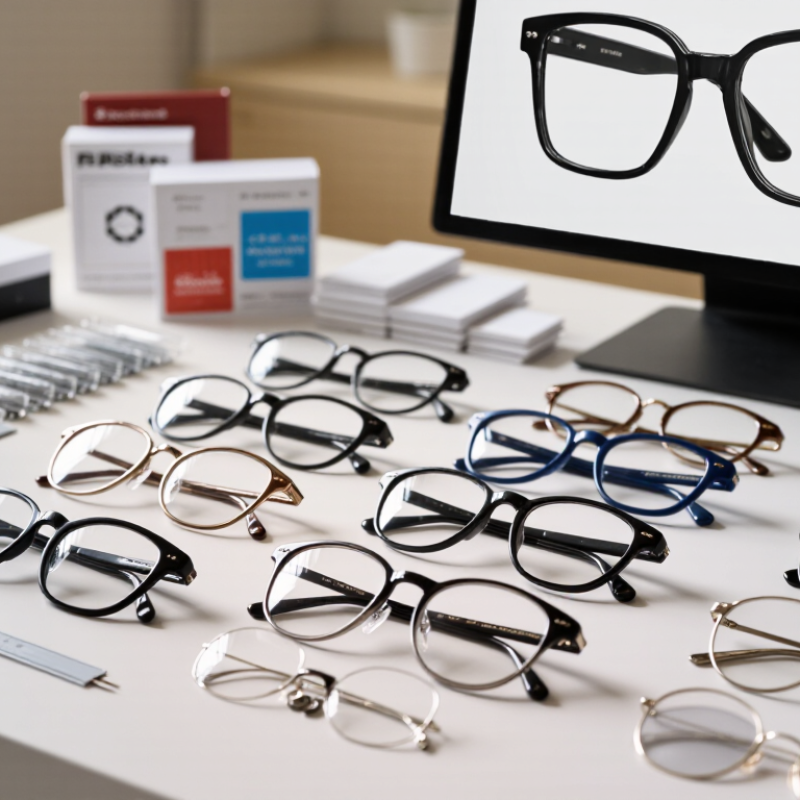
In 2026, global buyers are comparing prescription optical frames by fit, durability, and everyday comfort. Full-rim frames offer strong lens support and suit active routines. Semi-rimless designs look lighter but need careful lens edging. Rimless frames provide a nearly invisible appearance, although their exposed mounting points require gentle handling. Metal frames are adjustable, while lightweight plastic frames can offer warmer colors and broader sizing.
Materials are changing too. Titanium and other corrosion-resistant alloys remain useful in humid climates. Bio-based plastics are gaining attention, but buyers should request clear durability and composition information. Hypoallergenic finishes may help sensitive users, yet “skin-friendly” wording is not a medical guarantee. Check the details.
A reliable fitting process matters more than a fashionable silhouette. Buyers should confirm bridge width, temple length, lens height, and pupillary distance with a qualified optician. Digital try-on tools can narrow choices, but they cannot fully measure pressure behind the ears or slipping during movement. That limitation is easy to overlook. In my experience, flexible hinges and replaceable nose pads often improve long-term value, especially for frequent travelers. Still, more features can mean more repair points. Prescription strength, lens thickness, climate, and local service access should guide the final selection. Availability and safety requirements also differ by market, so buyers should review regional optical standards before ordering.
2026 Best Prescription Optical Frames for Global Buyers?
For global buyers, frame material shapes durability, comfort, and design flexibility. In practical sourcing, I compare weight, hinge movement, surface finish, and nose support. Acetate-like materials often provide rich color and easy adjustment. They can feel warm against the skin. Metal frames usually offer a slimmer profile and strong structural support. However, poorly finished edges may irritate the nose or temples. Material labels can mislead. Ask for composition details and sample testing.
Durability needs more than a strong appearance. I inspect hinge alignment, screw stability, lens groove accuracy, and resistance to repeated opening. A frame should survive ordinary handling without becoming loose after several weeks. Yet no material is perfect. My early preference for ultra-light frames overlooked their weaker balance on larger prescriptions. A slightly heavier frame may sit better and reduce lens movement. Small details matter.
Comfort depends on bridge shape, temple pressure, frame width, and lens weight. Buyers should test frames with prescription lenses installed, not only empty samples. Silicone nose pads can improve grip, while adjustable temples help different face shapes. Design also matters across markets, since color, size, and browline proportions reflect local preferences. I still misjudge fit from photographs. Clear size measurements and wearer feedback remain more reliable than appearance alone.
Comparing frame materials by durability, comfort, and design flexibility
Ratings use a typical 1–5 scale based on common material characteristics used in optical frames. Titanium and stainless steel generally provide strong durability, while TR90, polycarbonate, and acetate offer lower weight. Acetate usually provides the greatest color and shape flexibility. Actual performance varies with formulation, thickness, hinge construction, coating, and manufacturing quality.
2026 Best Prescription Optical Frames for Global Buyers?
Choosing Optical Frames for Different Face Shapes and Prescriptions
Choosing frames begins with the prescription, not a passing trend. For strong prescriptions, smaller round or oval lenses can reduce edge thickness. Full-rim frames usually hide lens edges better than thin rims. That detail matters. However, face-shape charts are only starting points. A square face may suit softer curves, while a round face may balance with gentle angles. Real faces rarely follow perfect categories.
Nose bridge height, temple length, and pupillary distance affect comfort more than appearance. An experienced optician should confirm monocular pupillary distance when possible. This measurement helps center each lens accurately. Progressive lenses also need enough vertical space for clear distance and reading zones. A narrow frame may look elegant but limit that corridor. It can be a poor choice.
Buyers with high prescriptions should compare lens materials, edge thickness, and frame durability. Lightweight materials may improve comfort, but they are not automatically the best option. A prescription optical frame should sit level, leave lashes untouched, and stay stable during normal movement. Check the written prescription date and fitting measurements before ordering internationally. Remote selection is convenient, yet online photos can mislead. Color, scale, and bridge fit may feel different in person. Rechecking measurements is worth the extra effort.
Global buyers should assess prescription optical frames against recognized standards, not attractive photographs alone. ISO 12870 covers essential requirements for spectacle frames, including construction, durability, and chemical resistance. ISO 8624 also supports consistent frame measurements. Fit is not universal. A 52-18-140 frame may suit one market but feel narrow across another facial profile. Buyers should request bridge width, lens height, temple length, and tolerance data before ordering. The World Health Organization estimates that at least 2.2 billion people have vision impairment worldwide, making accurate prescription compatibility commercially important.
Pricing requires more than comparing factory quotations. Grand View Research valued the global eyewear market at approximately 153.79 billion US dollars in 2023, with continued growth expected through 2030. However, market growth does not guarantee stable margins. Material grade, plating tests, packaging, freight, inspection, and rejected units can change the landed cost. A low quoted price can mislead. Data needs context. Supplier offers should include sample costs, minimum order quantities, production capacity, payment terms, and documented quality controls.
Reliability is measurable, although many buyers assess it too casually. Review recent inspection records, corrective-action reports, batch traceability, and on-time delivery rates. ISO 9001 certification can indicate a quality-management system, but it does not prove every frame is consistent. Independent pre-shipment inspection remains useful. Supplier audits should test hinge movement, coating adhesion, lens-groove accuracy, and carton protection. Some purchasing teams still overvalue certificates and undervalue repeat-sample performance. That weakness deserves attention.
International buyers need more than attractive prescription optical frames. Fit, documentation, production control, and after-sales support deserve equal attention. Start with a written specification. Record bridge width, temple length, lens shape, material, color tolerance, and acceptable weight. Ask for technical drawings and a physical sample before approving volume production. Measure everything.
A reliable buying checklist should also examine hinge strength, surface finishing, nose-pad security, and lens compatibility. Request test reports, material declarations, inspection records, and traceable batch information. Requirements differ across markets, so verify current import, labeling, and product-safety rules with qualified local professionals. Do not rely on a supplier’s verbal promise. Trust evidence. Clarify minimum order quantities, replacement policies, packaging standards, and shipping responsibilities in writing. One missing clause can create expensive confusion.
Production visits or independent inspections can reveal details that samples miss. Check frame alignment on a flat surface, open and close each temple, and inspect coatings under strong light. Keep retained samples for later comparison. In practical sourcing work, buyers often focus too heavily on unit price. That approach can overlook inconsistent sizing, slow communication, or weak quality control. I have also seen checklists become too complicated to use consistently. A shorter checklist with measurable checkpoints may work better. Leave room for review after the first shipment, because real customer feedback may challenge the original specification.
| Checklist Area | What to Verify | Practical Benchmark / Reference | Documents or Evidence | Buyer Decision Rule |
|---|---|---|---|---|
| Frame Size | Lens width, bridge width, and temple length | Common markings include measurements such as 52–18–140 mm; confirm all three dimensions rather than relying on a general size label. | Technical drawing, product specification sheet, and sample measurement report | Approve only when the measured dimensions remain within the agreed tolerance, preferably ±0.5 mm for key frame dimensions. |
| Material Selection | Frame polymer or metal type, skin-contact components, and component consistency | Common options include acetate-based sheet, injected cellulose-based or other polymers, stainless steel, titanium, and metal alloys. Material claims should be specific rather than described only as “premium.” | Material declaration, supplier specification, and laboratory composition report where required | Prefer clearly identified materials with traceable lot information and no unexplained material substitutions. |
| Optical Compatibility | Rim shape, groove design, lens seating, and prescription range | Confirm compatibility with single-vision, progressive, high-index, and safety-related lens requirements before bulk purchasing. | Lens-fitting guide, CAD drawing, glazing instructions, and trial edging feedback | Reject styles that require excessive lens stress, irregular bevels, or repeated manual adjustment during fitting. |
| Hinge Performance | Hinge construction, opening resistance, alignment, and screw retention | Test repeated opening and closing, side-to-side play, temple alignment, and screw loosening. Use a documented internal test method with a defined cycle count. | Hinge test record, inspection checklist, and pre-shipment quality report | Set acceptance limits before production; do not approve samples solely from visual inspection. |
| Durability Standard | Mechanical strength, deformation, corrosion, and finish resistance | Use ISO 12870 as a recognized reference for spectacle-frame requirements and test methods, while confirming the specific edition and applicable test scope. | Independent test report or factory laboratory report referencing the selected standard | Give preference to products with test results tied to a defined model, material, and production lot. |
| Surface Quality | Plating, coating, polishing, color consistency, burrs, and sharp edges | Inspect under consistent lighting for pinholes, peeling, uneven color, visible scratches, rough edges, and residue around hinges or nose pads. | Golden sample, approved color standard, AQL inspection report, and defect photographs | Use agreed major and minor defect limits; quarantine any lot showing coating flaking or sharp skin-contact edges. |
| Nose-Fit Design | Nose-pad material, pad-arm stability, bridge geometry, and adjustability | Stock should cover the target market’s bridge-fit needs, including low-bridge and adjustable-pad options where relevant. | Fit samples, dimensional drawings, and user-fit evaluation records | Select several bridge configurations instead of assuming one nose shape fits every regional customer. |
| Chemical Compliance | Restricted substances in frames, coatings, pads, screws, and packaging | For European sales, assess applicable REACH obligations, including SVHC communication duties and restrictions. Requirements vary by material and destination. | Declaration of conformity, material disclosures, and accredited chemical test reports | Obtain destination-specific compliance confirmation before shipment, not after customs or marketplace review. |
| Prescription and Medical Claims | Whether the product is sold as a frame, complete spectacles, or a regulated medical device in the destination market | A frame sold separately may have different obligations from finished prescription eyewear. Classification depends on the product and jurisdiction. | Regulatory classification, labeling review, and market-specific importer guidance | Confirm requirements with the local importer or regulatory adviser before using medical or corrective-vision claims. |
| Packaging and Protection | Individual protection, moisture control, carton strength, and packing efficiency | Each frame should be protected against lens-rim abrasion, temple deformation, dust, and moisture during multimodal transport. | Packing specification, carton drop-test record, carton dimensions, and packing photographs | Approve packaging only after a simulated transport review or representative shipment test. |
| Labeling and Traceability | Model code, size, material, country-of-origin information, lot number, and care instructions | Labels should match commercial documents and allow a defective lot to be isolated quickly. | Artwork approval, carton label, packing list, and lot traceability record | Do not release goods when product markings, carton labels, and invoices describe different specifications. |
| Customs Classification | Correct tariff classification for frames, parts, and complete optical products | HS heading 9003 covers frames and mountings for spectacles, goggles, or the like; the final subheading and duty depend on the destination tariff schedule and material. | Commercial invoice, packing list, HS classification rationale, and customs broker confirmation | Validate the destination-country tariff code before quoting landed cost or delivery terms. |
| Quality Inspection | Sampling level, defect classification, measurement method, and inspection timing | Define AQL levels and inspection conditions in the purchase order; ISO 2859-1 is a commonly used reference for attribute sampling. | Inspection plan, approved limit samples, inspection report, and corrective-action record | Use pre-production, during-production, and pre-shipment checkpoints for new or high-risk styles. |
| Commercial Terms | MOQ, lead time, payment terms, tooling charges, sample cost, and replacement policy | Record each term by model and color. Separate development lead time from production lead time and include inspection approval time. | Quotation, pro forma invoice, purchase order, and agreed quality annex | Compare total landed cost, not only unit price, including freight, duty, testing, rework, and defect replacement. |
| After-Sales Support | Spare parts, repairability, warranty period, complaint response, and replacement availability | Clarify availability of screws, nose pads, temples, hinges, and replacement frames for the expected selling period. | Warranty terms, spare-parts list, service-level agreement, and complaint procedure | Prioritize suppliers that provide written response times and a practical remedy for recurring defects. |
Acetate-like materials offer rich colors, warmth, and easy adjustment. Metal frames usually provide slimmer profiles and strong support. Poorly finished edges can irritate skin. Material labels can mislead, so request composition details and samples.
Inspect hinge alignment, screw stability, lens-groove accuracy, and surface finish. Open and close sample frames repeatedly. Check whether hinges become loose. Appearance alone is not enough.
Bridge shape, temple pressure, frame width, and lens weight all matter. Silicone nose pads can improve grip. Adjustable temples suit more face shapes. Test the frame with prescription lenses installed.
Smaller round or oval lenses can reduce visible edge thickness. Full-rim frames often hide lens edges better. Compare lens material, frame strength, and final weight. Very light frames are not always better.
Face-shape charts are useful starting points, not strict rules. Softer curves may balance angular features. Gentle angles may suit rounder faces. Real faces rarely match perfect categories.
Confirm bridge width, lens height, temple length, frame width, and pupillary distance. Monocular pupillary distance can improve lens centering. Progressive lenses need enough vertical space. Recheck everything.
Include material grade, plating tests, packaging, freight, inspection, and rejected units. Ask about sample costs and minimum order quantities. A low quotation may hide later expenses. Landed cost matters more.
Review recent inspection records, corrective actions, batch traceability, and delivery performance. Ask for documented quality controls and production capacity. Independent pre-shipment inspection remains useful. Certificates help, but they prove less than consistent samples.
Online photographs can distort color, scale, and bridge fit. I have misjudged fit from images before. Written measurements and wearer feedback are more reliable. A slightly heavier frame may sometimes sit better.
This guide to the best Prescription optical frames for global buyers in 2026 explains how to evaluate frame types, materials, durability, comfort, and modern design trends. It compares common options such as lightweight plastics, metal alloys, and flexible materials, while considering how each choice affects long-term wear, maintenance, and user comfort. The guide also shows how frame shape, bridge design, temple length, and lens requirements should match different face shapes and prescription needs.
For international optical buyers, the guide highlights the importance of reliable sizing, consistent quality control, recognized safety and manufacturing standards, transparent pricing, and dependable supplier communication. It also provides a practical buying checklist covering sample approval, material details, production capacity, packaging, inspection procedures, delivery terms, and after-sales support. By reviewing these factors together, buyers can make informed purchasing decisions and select frames that balance appearance, functionality, comfort, and supply reliability across different markets.